

environmental sustainability
Collaborating to help drive environmental progress
Creating a more sustainable aviation industry is a shared challenge, not something a single airline can solve on its own. That’s why we are working with partners across our value chain — from our customers and fuel suppliers to policymakers — to advance policy, support funding for more sustainable flight and strengthen the partnerships needed to facilitate change.
The role of policy
Policy is essential to narrowing the cost gap between SAF and conventional jet fuel and unlocking the broader energy transition needed to support SAF at scale. In the United States, (where United has used SAF in operations since 2016), several policy incentive programs help reduce the “green premium” on SAF to a smaller net premium that is still above fossil jet fuel but closer to being affordable at scale. When these incentives are layered and made predictable, they can support larger, longer-term investments in SAF projects.
Conventional jet fuel benefits from nearly a century of infrastructure, mature supply chains and fully amortized assets, while SAF producers must finance new facilities and build new supply chains, resulting in structurally higher costs. Policy can bridge part of this gap by rewarding technological innovation, de-risking capital projects and supporting early plants until costs fall through learning and scale effects.
At the same time, scaling SAF depends on broader clean energy “building blocks” such as carbon capture, green hydrogen and renewable electricity, which sit mostly outside aviation’s direct control. As these technologies expand to serve multiple sectors, SAF producers can tap into lower-cost inputs, making SAF more competitive and enabling aviation to play its role within a wider net-zero energy transition.
Advocating for the right policies
We engage with policymakers both domestically and internationally to support opportunities to scale SAF cost-effectively. In the U.S., United is a member of the Sustainable Aviation Fuel Coalition. This roughly 50-member coalition works to rapidly scale investment in the SAF sector and advocate for the policies necessary to drive U.S. leadership in the emerging SAF marketplace. Scaling U.S. SAF production will provide critical support for farmers, rural communities, fuel manufacturers and other related industries across the country. Through policy reforms, the U.S. can boost our SAF production, become a net exporter of SAF and maintain our leadership in this rapidly evolving source of energy.
Through this domestic coalition, we are advocating for robust and durable tax incentives designed to encourage domestic production of low-emission aviation fuels. These incentives would accelerate domestic SAF production, strengthen U.S. energy and climate leadership and reinforce America’s position as the world’s most competitive producer of cleaner, lower-carbon jet fuel.
Learn more
Learn more about our Policy Priorities and Lobbying and Political Engagement.

Strengthening industry-wide partnerships
United collaborates on a global scale to facilitate the change needed to advance sustainability within our industry through various associations and working groups such as Airlines for America (A4A), the IATA and the Air Transport Action Group (ATAG).
Notably, in 2025 United chaired A4A’s SAF Committee, was a member of the global IATA Sustainability and Environment Advisory Council (SEAC) and was involved in regular ATAG working groups. In addition, United is a member of the Global Business Travel Association’s (GBTA) Sustainability Leadership Council.
This industry collaboration helps address shared challenges and advance solutions that benefit air travel.
Partnering with our customers
Furthering more sustainable aviation requires collaboration across the value chain, including partnering with our customers. In 2021, United launched the Eco-Skies Alliance, an innovative program which aggregates corporate SAF demand to support the growth of the SAF market. This program helps corporate customers in their decarbonization journey, as the SAF certificates can be used towards abating business travel and air freight emissions, while developing a demand signal that SAF is an important decarbonization tool across industries.
Since the program’s launch, our customers have supported the purchase of over 33.2 million gallons of SAF across seven airports globally, resulting in the abatement of approximately 360,096 metric tons of CO2e,Footnote 1 the equivalent of over 313,000 first-class flights between Newark and San Francisco.
As an example of the impact this partnership can provide, in 2025 United Airlines, in collaboration with DSV and Microsoft, worked to reduce lifecycle GHG emissions of air freight operations by 100,000 metric tons CO2ethrough the use of SAF. Phillips 66 served as the primary SAF provider to our operations.Footnote 2 This cross-industry approach, further supported by SAF incentives like the Illinois’ SAF Purchase Credit, is an example of driving scalable SAF adoption.
Learn more
We have partnered with leisure customers to raise awareness of their travel’s environmental impact — and to offer more fuel-efficient flight options. Read more on the Eco-Skies Alliance site.
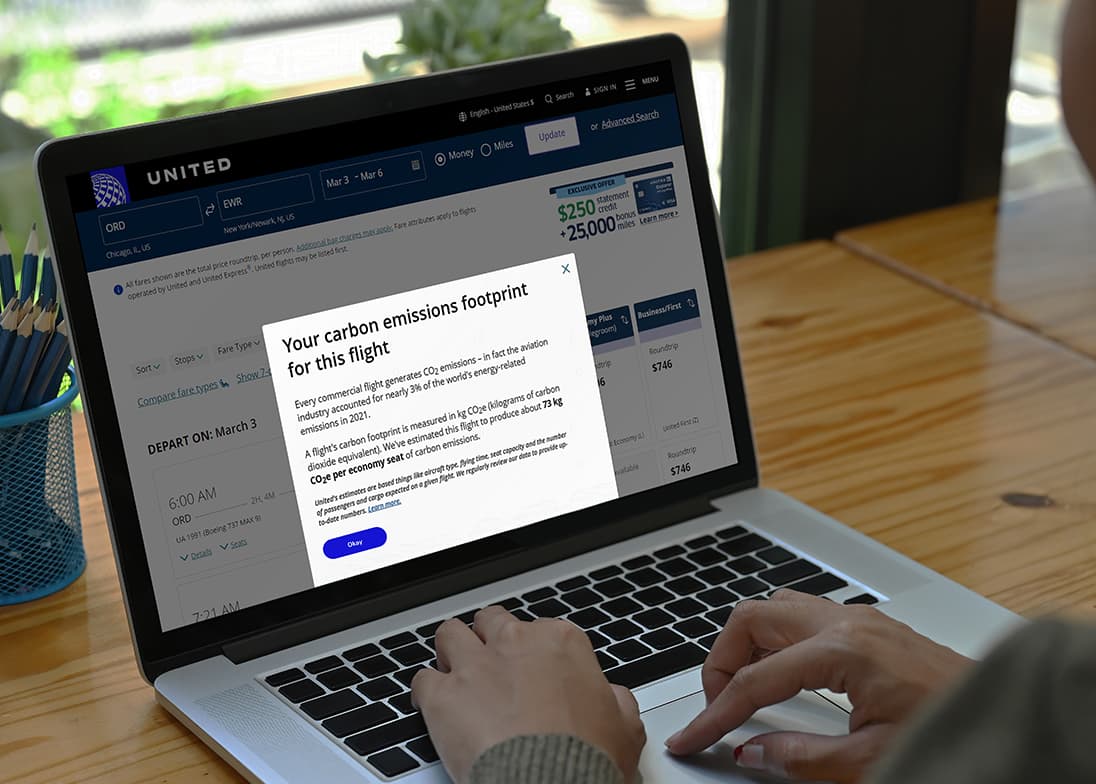
United was the first U.S. carrier with international operations to provide emissions estimates in our booking path, using our operational data to estimate our fleet’s performance.
With these values, our customers can compare the carbon footprint of their flights and learn more about how factors such as new aircraft can help reduce travel emissions.
In 2024, United expanded the role our customers have in our SAF adoption through the Sustainable Flight Account (SFA). Any customer purchasing flights directly on our website or mobile app can contribute to our sustainability initiatives via a dynamic toggle, ranging from $1 to $7 per reservation. When stacked with federal and state incentive programs, funds contributed to the SFA have allowed United to purchase 5.6 million gallons of SAF.Footnote 3
Forging opportunities to research emerging climate considerations
Along with carbon emissions, flying also releases non-CO2 emissions. These include nitrogen oxides, water vapor, sulphate aerosols, soot aerosols and the associated formation of condensation trails (also known as contrails), which are ice clouds formed when water in high-altitude air condenses on particles from engine exhaust and freezes.
Emerging scientific consensus from certain studies is that the warming effect from contrails — created when persistent contrails block heat from escaping to space — is greater than the cooling effect created when contrails reflect solar radiation back to space. United is collaborating with various stakeholders to improve the understanding of opportunities to mitigate these impacts.
We recognize that this is a complex issue that cannot be solved by airlines alone; it requires multi-stakeholder solutions with implications for engine and aircraft manufacturers, fuel producers, air navigation service providers, air traffic control and government leaders. However, more research is needed to better predict contrail formation and understand the potential climate trade-off from mitigation solutions. We must also be able to quantify the climate impact of any action, which will require additional research from climate scientists and academia.
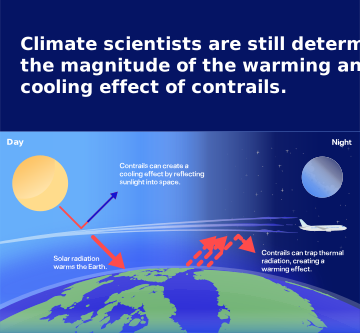
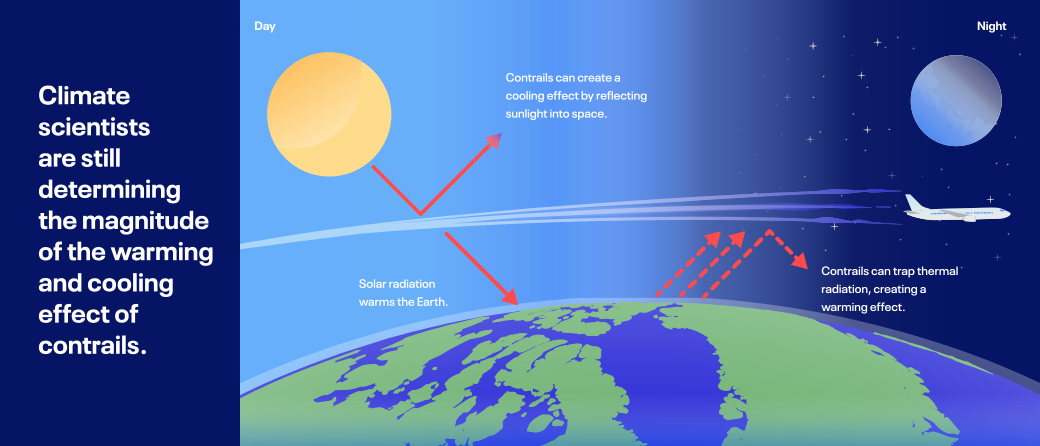
Illustration of the Earth, sun and moon, with a plane flying in the atmosphere and red arrows pointing from sun to Earth, and from earth to atmosphere, depicting how solar radiation warms the earth and contrails can reflect sunlight into space and create a warming effect on Earth.
Footnotes
- Eco-Skies Alliance abated CO2e value based on book-and-claim accounting; SAF may have been purchased for use by United Airlines or other entities.
- Phillips 66 will supply up to 11 million gallons of Sustainable Aviation Fuel (SAF) to United Airlines to support the cross-industry collaboration.
- Purchased gallons include SAF already delivered and gallons pending delivery with executed contracts with suppliers.