


Environmental sustainability
Our environmental strategy
The reality of flying
Connecting people and uniting the world is what we do. Air travel sits at the heart of how people and goods move across the globe. At United, we continuously strive to make these connections with greater efficiency, greater comfort and lower environmental impact. But keeping the world connected also means facing a tough reality: Aviation is one of the hardest sectors to decarbonize.
Today, liquid fuels remain the most viable option capable of meeting the energy requirements of large aircraft — and no alternative is expected to reach that scale for decades. As a result, air travel will not be free of greenhouse gas (GHG) emissions in the near term. We believe progress on reducing emissions will continue, but it will be gradual as technologies mature, fuel markets scale and policy frameworks evolve.
United Airlines is on a mission to help redefine the future of air travel with sustainability anchored in our business strategy. As we do so, we are focusing on the levers we can move: Flying more efficiently, renewing our fleet, and accelerating the availability and deployment of sustainable aviation fuel (SAF) where operationally and commercially viable.
Our goals and strategy
United Airlines was the first global airline to announce an aspiration of achieving net-zero GHG emissions by 2050 without relying on voluntary, traditional carbon offsets.Footnote 1
Our GHG emissions reduction ambitions:
2035: Near-termWe aim to reduce GHG emissions intensity 50% by 2035 (from a 2019 baseline).Footnote 2 This has been validated by the Science Based Targets initiative (SBTi).
2050: Long-termWe aim to reduce our GHG emissions by 100% — reaching net zero by 2050 — without relying on voluntary, traditional carbon offsets.
Our strategy centers around four key pillars

Drive fuel efficiencies and innovation in flight
Our primary objective in reaching our goals is to reduce our current emissions from conventional jet fuel consumption, which is the single largest contributor to our environmental footprint.

Adopt more sustainable alternatives
Our objective is to help commercialize and scale sustainable aviation fuel (SAF), as it is a technological solution in development today that can abate emissions from flight operations.
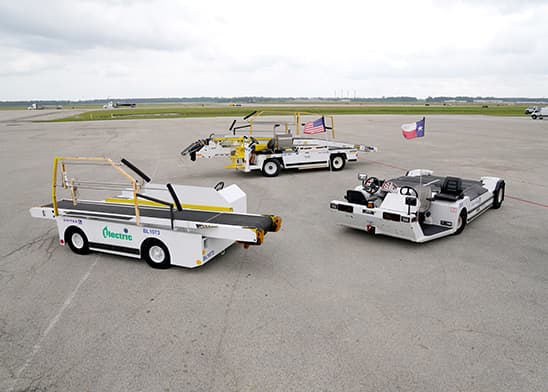
Integrate sustainability efforts at every altitude
Our responsibility to address our environmental impact extends beyond the emissions generated from our flights to operations across our business.
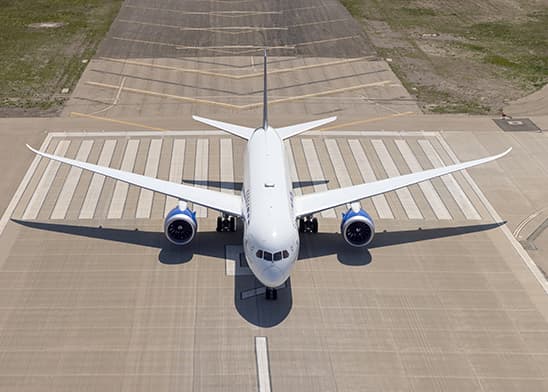
Collaborate with partners
Our journey towards more sustainable aviation is a collective effort. We are working with customers, employees, airports, suppliers, cross-industry partners and policymakers to advance solutions for aviation.

Lauren Riley, Chief Sustainability Officer

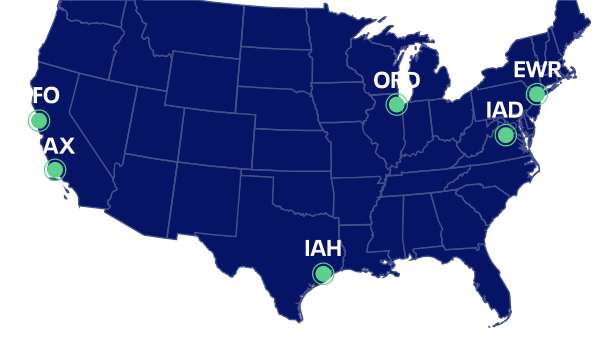
United connects people, communities and economies around the world — and we’re determined to do that responsibly, with a clear focus on reducing our emissions and strengthening our business for the long term. In 2025, we made significant progress by expanding the availability and use of SAF — becoming the first airline to use a SAF blend at Newark Liberty International Airport (EWR) and Washington Dulles International Airport (IAD). Now, we’re building on this momentum, introducing a SAF blend at George Bush International Airport (IAH) and expanding use at our hometown hub, Chicago O’Hare International Airport (ORD). While SAF currently makes up a small portion of our total fuel, each new blend and each hub we bring online moves the industry closer to a viable market.
2025 Domestic SAF DeliveriesFootnote 3
Footnotes
- In this report, “traditional carbon offsets” refer to carbon credits generated through the avoidance and/or reduction of CO₂ emissions that would have otherwise occurred outside a company’s value chain. Traditional carbon offsets do not include certificates conveying the attributes of renewable energy or SAF or credits related to the removal of CO₂ from the atmosphere.
- The United complete target, as validated by the SBTi, states “United Airlines commits to reduce Scope 1, 2, and well-to-wake jet fuel GHG emissions, including Scope 3 category 4, upstream transportation and distribution 50% per revenue ton kilometer (RTK) by 2035 from a 2019 base year. The target boundary includes biogenic emissions and removals from bioenergy feedstocks. Non-CO₂e effects, which may also contribute to aviation-induced warming, are not included in this target. United Airlines, Inc. commits to report publicly on its collaboration with stakeholders to improve understanding of opportunities to mitigate the non-CO₂e impacts of aviation annually over its target timeframe.”
- Voluntary SAF deliveries were also taken internationally at Amsterdam Airport Schiphol (AMS) and London Heathrow Airport (LHR).