

Environmental sustainability
Sustainable Aviation Fuel (SAF)
Sustainable aviation fuel, or SAF, can emit up to 85% fewer GHG emissions than conventional jet fuel.Footnote 1 While GHG emissions are still released during the collection, production, transport and combustion of SAF, total emissions across its lifecycle are lower than those of fossil-based alternatives. While we already use SAF in our existing aircraft and infrastructure, the current supply is limited, and it costs more than traditional jet fuel. That’s why we are working to scale SAF supply and usage through strategic investments and policy support.
Where SAF stands today
Today, SAF supply accounts for just a small fraction of global aviation fuel demand and remains well short of the volumes needed to reduce sector-wide emissions. Across the industry, estimated global SAF production in 2025 was roughly 634 million gallons, compared with nearly 107 billion gallons of conventional jet fuel used worldwide. This means that SAF currently represents only 0.6% of total aviation fuel usage. But, as we work toward our climate goals, United continues to lead the industry in action to help the SAF market achieve that scale.
We doubled our SAF usage in 2025
In 2025, United used roughly 27.7 million gallons of SAF — a 104% increase over the prior year — but this still accounted for only about 0.7% of our total annual jet fuel use of more than 4.1 billion gallons. We also added to our SAF operations, using a SAF blend for the first time at three new airports in 2025: George Bush Intercontinental Airport (IAH), Newark Liberty International Airport (EWR), and Dulles International Airport (IAD), growing our SAF usage portfolio to six hubs across our network.
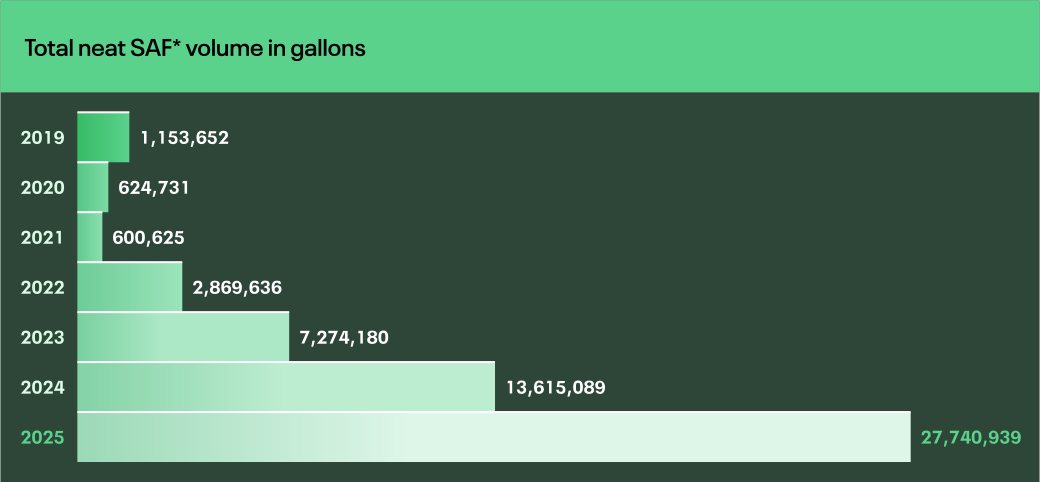
Horizontal bar chart that represents in green the volume in gallons that we have been scaling our SAF usage each year from where we are in 2025 to where we were in 2019.
- 2019: 1,153,652 gallons
- 2020: 624,731 gallons
- 2021: 600,625 gallons
- 2022: 2,869,636 gallons
- 2023: 7,274,180 gallons
- 2024: 13,615,089 gallons
- 2025: 27,740,939 gallons
*Total neat SAF refers to the unblended SAF procured by United. This SAF volume then needs to be blended with conventional jet fuel in order to be used in our operations. To protect the integrity of our SAF use, all the SAF we purchase is certified under internationally recognized sustainability schemes, such as the International Sustainability and Carbon Certification system.
Scaling SAF usage
Increasing the use of SAF will require closing the cost gap with conventional jet fuel while building the infrastructure and policy support needed to sustain long-term investment. Today, SAF can cost up to five times more than conventional jet fuel, reflecting both higher costs to collect and process feedstocks and the significant capital required to develop new production facilities.
Since cost and supply remain the primary constraints, United continues to engage with policymakers and customers to create clearer demand signals and more predictable policy frameworks to help unlock new SAF production.
Learn more
To discover how United is advocating for more robust SAF policy and investing in sustainable aviation technology, read the Collaborating to Help Drive Environmental Progress section.
SAF feedstocks and pathways
Commercial-scale SAF is currently sourced primarily from waste-based feedstocks using established conversion processes, such as using hydro-processed esters and fatty acids (HEFA). The HEFA SAF pathway is expected to play a prominent role in decarbonizing our GHG emissions (contributing 18.7% of the illustrated reduction in 2050).Footnote 2 However, global availability of waste oils and fats is limited, so additional SAF pathways will be necessary for United and the aviation industry to meet long-term decarbonization goals.
By 2050, a significant portion of our SAF mix may come from second- and third-generation fuels made from more abundant resources or through technologies that combine captured carbon with green hydrogen. If these pathways reach commercial scale, they could deliver greater lifecycle emissions reductions than today’s SAF and help diversify feedstock markets and supply geographies.Footnote 3 However, they depend on several factors that do not yet exist at scale, including widespread green hydrogen production, new production infrastructure and regulatory approval for higher SAF blending limits.Footnote 4
Available today First generation SAF
Feedstocks
Waste-based fats, oils and greases like used cooking oil, animal fats and other waste byproducts
Constraints
This feedstock is used to make other bioproducts, like renewable diesel, and the current supply does not meet the aviation industry’s fuel demand
Expected commercial availability Footnote 5 near 2030 Second generation SAF
Feedstocks
Biomass feedstock like forestry waste, fuel crops and alcohols that can be turned into SAF
Constraints
Will require large capital investments to build first-of-a-kind plants; will take time to reach economies of scale
Expected commercial availability Footnote 5 near 2040 and beyond Third generation SAF & removals
Feedstocks
Carbon removals, clean hydrogen
Constraints
Limited scale and commercialization of carbon removal, clean hydrogen technologies and infrastructure
Our SAF leadership
At United, we are focusing on the parts of the challenge we can directly influence by scaling the use of certified SAF.
2009First U.S. airline to conduct a SAF test flight
2015First investment made in SAF technology
2016First airline globally to use SAF blend in ongoing operations
2020Announced commitment to reduce emissions by 100% by 2050 without offset
2021Launched United Airlines Ventures and Eco-Skies Alliance
2022First U.S. airline to announce expansion of voluntary SAF usage at an international airport – AMS
2023Launched the United Airlines Ventures Sustainable Flight Fund
2024Created Sustainable Flight Account, first airline to introduce SAF to ORD
2025Began using SAF at three additional hubs – EWR, IAD, IAH – bringing SAF to six out of seven domestic hubs
Investing for scale
United Airlines Ventures is a corporate venture capital arm that focuses on investing in start-ups developing technologies in aerospace, next-generation air traffic control and aviation infrastructure, the energy transition and AI-driven travel innovation. United expanded this approach by creating the United Airlines Ventures Sustainable Flight FundSM (the Sustainable Flight Fund). This first-of-its-kind investment vehicle is designed to support start-ups focused on decarbonizing air travel and its associated energy supply chains, including through research, production and technologies associated with SAF. Altogether, the Sustainable Flight Fund and its 22 corporate partners have committed more than $200 million to explore investments in early-stage companies working on SAF and related technologies, while collaborating to provide strategic expertise to help the Sustainable Flight Fund’s portfolio companies reach commercialization. Through UAV and UAV’s Sustainable Flight Fund, we support the broader energy transition that will make SAF more scalable and cost-effective over time.
In 2025, the Sustainable Flight Fund announced investments in two start-ups: Twelve, which is developing power-to-liquid fuels that combine captured carbon, renewable electricity and hydrogen to produce SAF, and Heirloom, which is scaling direct air capture technology with the potential to provide low-carbon CO₂ for multiple sectors. These investments show how our capital is directed both to SAF-specific pathways and to enabling technologies — such as carbon removal and clean power — that can reduce lifecycle emissions across industries while strengthening the building blocks required for future SAF production.
Learn more
Discover more about United Airline Ventures and its portfolio companies.
Footnotes
- SAF used by United has up to 85% lower GHG emissions than regular jet fuel when we count all its emissions, all the way from how it’s made and delivered to the airport, to when we use it (these are called ‘lifecycle emissions’). However, this does not mean our current use of SAF reduces our carbon footprint by 85%.
- United estimates each SAF lever (i.e., today’s commercial SAF, second generation SAF and third generation SAF) contribution to the roadmap through review of publicly available SAF projection forecasts: 1) Waypoint 2050 Report; 2) ICAO LTAG Report; 3) Making Net-Zero Aviation Possible - Aviation Transition Strategy; and 4) ICCT Vision 2050 - Aligning Aviation with the Paris Agreement. United estimates our share of SAF production using historic company SAF consumption, announced SAF policies and future offtake projections. Combined, the calculation results in an approximate 67.5% reduction in emissions.
- SAF with greater than 100% emissions reductions refers to alternative jet fuels produced with carbon removals by incorporating carbon dioxide (CO₂) removal into the production process. Carbon removals differ from traditional carbon offsets because they directly remove carbon from the atmosphere and are measurable, quantifiable and durable. The resulting fuel’s emissions reductions can be greater than 100% on a lifecycle basis, if more CO₂ is captured than emitted during production and combustion. As a result, United believes that SAF with such reductions offers one potential option for addressing residual emissions; carbon removal credits offer another. This lever incorporates a best-case scenario assumption for third-generation SAF availability.
- United anticipates NextGen SAF production scaling based on: publicly available SAF projection forecasts (see Footnote 5 in the Illustrative decarbonization roadmap section, CATF Decarbonizing Aviation 2024 Report and IATA’s Direct Air Capture and Storage Report); offtake discussions with NextGen SAF project developers; an assumed progress in renewable energy technologies; advancements in SAF production methods and evolving regulatory standards. ASTM approval for SAF blending limits ensures that aviation fuel — when mixed with SAF — meets safety and performance standards without requiring changes to aircraft or fueling infrastructure.
- This refers to SAF availability in material terms commercially.