

Safety
United Safety Management System
As our airline grows, we continue to place a strong focus on safety. United employs over 113,000 people and works proactively to reduce risk and uphold the highest level of safety for both our customers and employees.
Our Safety Management System (SMS)
Our comprehensive, formalized approach to managing safety is reinforced through close alignment with external standards and requirements, particularly those set by the Federal Aviation Administration (FAA) and the International Civil Aviation Organization. Backed by our vigilant safety mindset and data and trend analysis, our SMS supports regulatory compliance, strengthens our safety standards and provides a structured way to identify hazards and track corrective actions. It also enables collaboration across divisions, flying partners, business partners, industry organizations, original equipment manufacturers, airports and maintenance and repair stations — to ensure that the most effective mitigations are in place.
Constant improvement and training
With the operating environment and regulatory landscape throughout commercial aviation constantly evolving, we adapt our SMS as necessary to address both current and emerging safety risks. United also continues to extend our SMS beyond regulatory requirements.
One way we manage safety risks is by using data science, combining the strengths of our Digital Technology, Safety and Operational teams. Together, they collaborate to leverage new technologies like generative AI and natural language processing to proactively identify emerging safety hazards and enable our safety professionals to implement effective solutions that ensure the safety of our customers and employees.
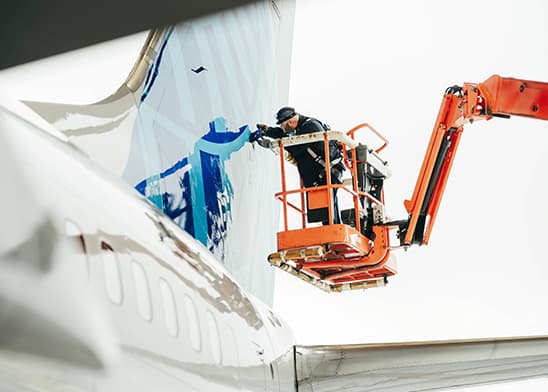
Our No Small Roles in Safety strategy has a simple meaning: Every one of our (more than 113,000 and growing) team members’ actions add up to something big! Every day, our employees execute critical standard operating procedures. As part of the United FAA-Approved Safety Management System (SMS), this strategy emphasizes that the seemingly little but important things — from ensuring the aisles are clear of debris to making sure chocks and cones are in good condition — require attention too. Our SMS is designed to equip every employee with a clear understanding of their responsibility for maintaining the highest level of safety performance for our customers and employees. This shared understanding is integral to our culture.
United Safety Management System
- Safety Promotion
- Safety Policy
- Safety Assurance
- Safety Risk Management
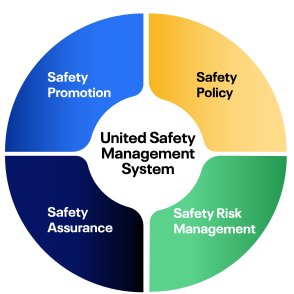
Four components of the United Safety Management System
The SMS is designed around predictive, proactive and reactive assessment and action. It is built on the four key components below.
United Safety Management System
- Safety Promotion
- Safety Policy
- Safety Assurance
- Safety Risk Management

1. Safety policy
Demonstrates senior leadership commitment to safety and clear/measurable safety objectives:
- Management commitment, involvement and advocacy
- Clear roles, responsibilities and relationships
- Procedures and controls
In keeping with our commitment to safety and as a requirement of the established FAA SMS Part 5 Rule, United develops key safety objectives that are carefully curated by each operating team to reduce our safety risks. These objectives include items such as reducing our procedural errors within all operational teams, integrating our data into an industry tracking data exchange and increasing hazard awareness.

2. Safety risk management
Identifies hazards, analyzes risks and evaluates controls to mitigate risks:
- Risk analysis and assessment
- Hazard identification
- System analysis
- Controlling risk
As we continue to grow our company, we are proactively identifying areas of risk and expanding our safety efforts to keep our operations safe and efficient. We have also strengthened our root cause analysis by revamping the overall process and investing in a system that allows us to get to the core of safety issues to avoid repeat occurrences. Key areas of focus include adding new stations and maintenance facilities, analyzing equipment requirements to support our new aircraft and analyzing gate area and baggage room impacts.

3. Safety assurance
Evaluates the effectiveness of risk-control strategies:
- Performance monitoring and measurement
- Data acquisition process
- Analysis and assessment
- Management of change
- Continuous improvement
Our five operation-specific safety reporting programs cover dispatch safety, flight safety, ground safety, inflight safety and technical operations safety. All programs are voluntary and non-punitive — this is in keeping with our just culture, which aims to identify and resolve safety concerns and hazards that could result in injuries, damage and accidents. These programs are an industry best practice and supported by the FAA. Recognizing that voluntary reporting only works when employees trust the system, we strive to foster an environment where employees feel encouraged and comfortable reporting safety concerns and errors, as this ultimately improves overall safety at our company.

4. Safety promotion
Fosters a positive safety culture by providing training, education and communication:
- Safety culture
- Competencies and training
- Communication and awareness
Voluntary safety reporting
Our well-established non-punitive safety reporting program, the Aviation Safety Action Program, is accessible to every employee. Reporting participation remained consistent from 2024 to 2025, delivering valuable information and insights that help improve our safety protocols.
Safety reports identify potential hazards in the system and are shared with process owners through the United SMS. We continue to leverage data analysis to identify potential risk areas and risk mitigation effectiveness. Resolutions and corrections that stem from the program are then communicated throughout the Company.

The My Safety App, our dedicated safety reporting app for United team members, provides a status report, two-way communication and custom notifications. It is available on all frontline employee company devices, making reporting quicker and easier. Reports submitted via the mobile app, versus desktop, were 60% in 2025.
Emergency preparedness
An integral part of our safety culture is maintaining a best-in-class emergency response program that supports resiliency and preparedness for the evolving threat landscape facing the aviation industry. We partner with our Enterprise Risk Management, Digital Technology and Cyber Defense teams and industry partners to identify high-probability and potentially impactful threats and to design comprehensive mitigation strategies. These strategies are reinforced through structured education, training and exercises.
Emergency response is an enterprise-wide effort that brings together leaders from across the Company to plan for and, when necessary, respond to emergencies. Our Emergency Operations Center serves as the central command and control mechanism, coordinating 32 business teams that are equipped and trained to manage critical events.
Emergency response preparations
Quarterly drills
We conduct quarterly drills designed to test response capabilities for critical events, including aircraft accidents, natural disasters, active shooter incidents, cyberattacks and civil unrest. This comprehensive approach includes collaboration with our Star Alliance partners, vendor partners, airports where we operate, and government agencies such as the National Transportation Safety Board.
Fourth quarter exercise
Our emergency response exercise in the fourth quarter of 2025 focused on readiness for a critical technology transition affecting our booking, inventory and passenger management systems. This targeted exercise generated valuable insights into our organizational response capabilities during major system changes and potential technology disruptions. The learnings informed protocols for potential future technology outages. This proactive approach to integrating technology-risk into our strategic planning framework will help inform our response resilience planning and supports operational continuity while improving our ability to manage complex system transitions and unexpected technology challenges that could impact our operations.
SMS discipline application
United applies SMS discipline to our emergency response drills, using a structured approach to identify and mitigate potential hazards in a systematic way.
Focus months
Each March and April, our annual “Focus Months” feature targeted workshops and campaigns designed to support business teams across the enterprise in updating Business Continuity and Emergency Response plans. Teams use this time to train, educate and exercise their plans, strengthening our overall preparedness and resilience as our operating environment evolves.
Post-event debriefs
Following every emergency event — whether an exercise or an actual incident — we conduct formal debriefs with all responders and support organizations to drive continuous improvement in our emergency response capabilities. These reviews take place in a safe, non-punitive environment where we examine what worked well and where we can enhance our response.
Reflecting our commitment to industry-wide safety and preparedness excellence, we have also held collaborative debriefs with other air carriers. These debrief sessions give us valuable insights into real-world incidents experienced by our peers and help us identify potential vulnerabilities and opportunities within our own emergency response protocols.